💰 The Cost of Commercial Solar Panels in Canada (2026 Guide)
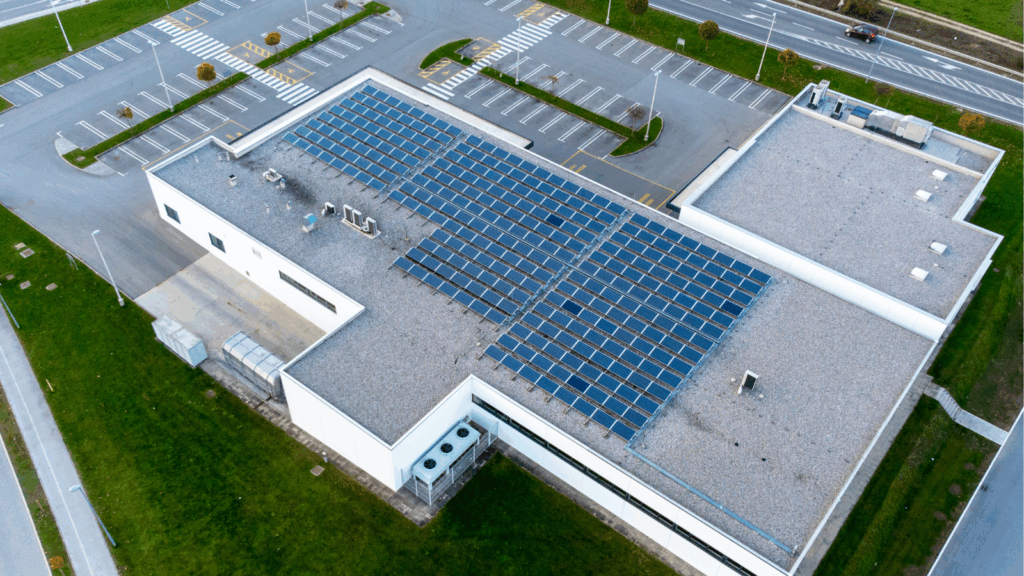
For Canadian businesses, commercial solar is no longer just a feel-good sustainability project. It’s a serious financial tool.
Whether you manage a warehouse in Calgary, a manufacturing facility in BC, a farm in the Prairies north of Edmonton, or a portfolio of commercial real estate, a well-designed solar array can lock in a portion of your electricity costs for decades, deliver attractive returns, and strengthen your ESG reporting—all at the same time.
But if you're thinking about installing Commercial Solar here are the important questions:
At MAG Solar, our commercial team sees the same pattern over and over again:
- ⚡Power prices are volatile.
- 🏢 Buildings have under-used roof or site area.
- 🍁 Incentives and tax rules are extremely favourable for clean energy.
When you put those three pieces together, commercial solar often moves from “nice idea” to “obvious capital project.”
This guide walks through what commercial solar really costs in Canada in 2026, how the Clean Technology Investment Tax Credit (CT ITC) and accelerated depreciation (CCA) shrink the net cost, how Alberta and BC’s market structures change the math, and how MAG Solar approaches design, ROI, and payback for commercial clients.
💵 What “the cost of commercial solar” actually means
When people ask, What is the cost of commercial solar panels in Canada?”, what they’re really asking is a combination of:
Questions:
💰 How much capital do we need to invest?
🍁 What incentives and tax benefits reduce that number?
🏢 How quickly does the project pay for itself?
🤔 What’s the long-term return compared to doing nothing?
🔧 Typical installed cost ranges for commercial solar in Canada
Every project is different, but in 2026, most well-planned, turn-key commercial rooftop systems will generally fall somewhere in these bands:
Smaller commercial / farm-scale systems (<100 kW)
Often in the $1.70–$2.00/W range, depending on location and complexity.
Mid-scale commercial systems (100–500 kW)
Typically $1.60–$1.90/W, as fixed costs are spread over more capacity.
For Example:
A 250 kW system at $1.75/W would have a gross installed cost of ~$437,500.
Larger systems (500–1,000 kW)
Frequently $1.30–$1.50/W on clean, accessible roofs.
Very large systems (1–5 MW+)
With strong economies of scale, some projects can land in the $1.20–$1.40/W range, especially on big, simple roofs or ground-mounts.
For example:
A 1 MW system at $1.35/W would be ~$1,350,000 before any incentives.
🏢 What really drives the cost of a commercial solar project?
Beyond raw size, several key factors shape the final project cost and ROI.
System size and economies of scale
System size is the biggest single driver. A 75 kW array on a farm shop, a 300 kW array on a supermarket, and a 1.5 MW array on a distribution centre are three different worlds.
Larger projects:
- Spread fixed engineering, mobilization, and permitting costs across more watts.
- Often qualify for better equipment pricing.
- Use labour and lifting equipment more efficiently.
This is why you’ll often see $/W drop as systems cross into higher capacity bands.
Roof type, condition, and complexity
The roof is your “foundation” for a rooftop system. Costs and feasibility are affected by:
- Membrane and deck type (TPO, EPDM, BUR, metal, etc.)
- Slope and parapet height
- Condition and remaining life
- Obstructions and how much clear area remains
On flat roofs, MAG Solar’s engineers and structural partners determine whether ballasted racking, mechanical attachments, or a hybrid approach makes the most sense for both structure and long-term waterproofing.
On sloped metal roofs, we can often use engineered clamp systems that minimize roof penetrations and install very efficiently.
If a roof is near end-of-life, we’ll often recommend addressing that before or alongside solar. Re-roofing under an existing array later is technically possible but disruptive and more expensive.
Structural capacity
Commercial arrays add weight to the roof—primarily from racking and ballast on flat roofs. A structural engineer will:
- Review existing drawings and, if needed, site conditions
- Model additional dead load and wind/snow loads
- Identify zones that can carry full array loading and any that may need lighter design or reinforcement
Some buildings require targeted upgrades; others can accept a full array with no structural upgrades at all. MAG Solar’s team works with structural specialists to find solutions that respect your safety factors without unnecessarily inflating costs.
Electrical service and interconnection
With strong economies of scale, some projects can land in the $1.20–$1.40/W range, especially on big, simple roofs or ground-mounts.
For example:
A 1 MW system at $1.35/W would be ~$1,350,000 before any incentives.
Location, access, and labour
Labour rates, crane access, staging area, weather windows, and project phasing all affect cost.
A big, open warehouse roof near a major urban centre will generally be more cost-effective per watt than a remote, complex site that requires special access and mobilization. We factor those realities into both price and schedule so there are no surprises during construction.
🏗️ How much roof or land do you actually need?
A good rule of thumb for planning is:
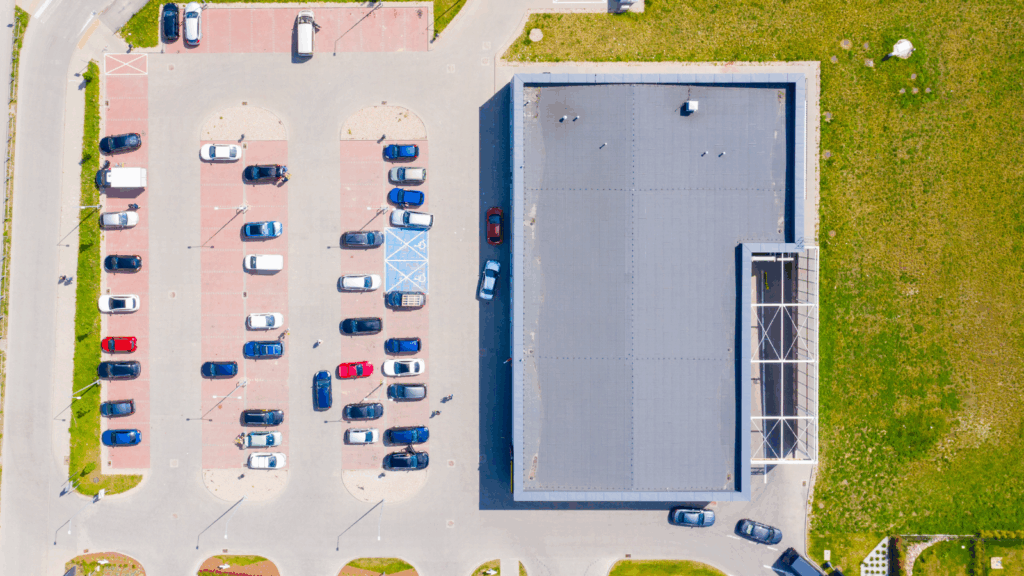
≈ 50 sq. ft. of flat roof per kW of solar
On many commercial flat roofs, a 500 kW system will require around 25,000 sq. ft. of usable roof area once you account for setbacks, parapets, and space between rows.
Sloped roofs can sometimes fit more wattage into less square footage because the modules mount flush to the surface. Ground-mount systems usually need more land per kW due to spacing between rows.
What matters is not just total roof size, but usable roof area:
- A large roof cluttered with vents, skylights, and HVAC units may host less solar (with more design complexity) than a slightly smaller, clean warehouse roof.
- Roofs with big open “blocks” are much easier and cheaper to build on than roofs that force your array into lots of little islands.
Part of MAG Solar’s early work on a project is doing a detailed roof and obstruction layout so we know how much capacity your building can realistically host at a good $/W.
🍁 Federal incentives: shrinking the net cost of commercial solar
Where commercial solar really becomes compelling in Canada is in the incentive stack. You’re not just installing a system; you’re also unlocking significant tax benefits. Read our Full Guide Here
Clean Technology Investment Tax Credit (CT ITC)
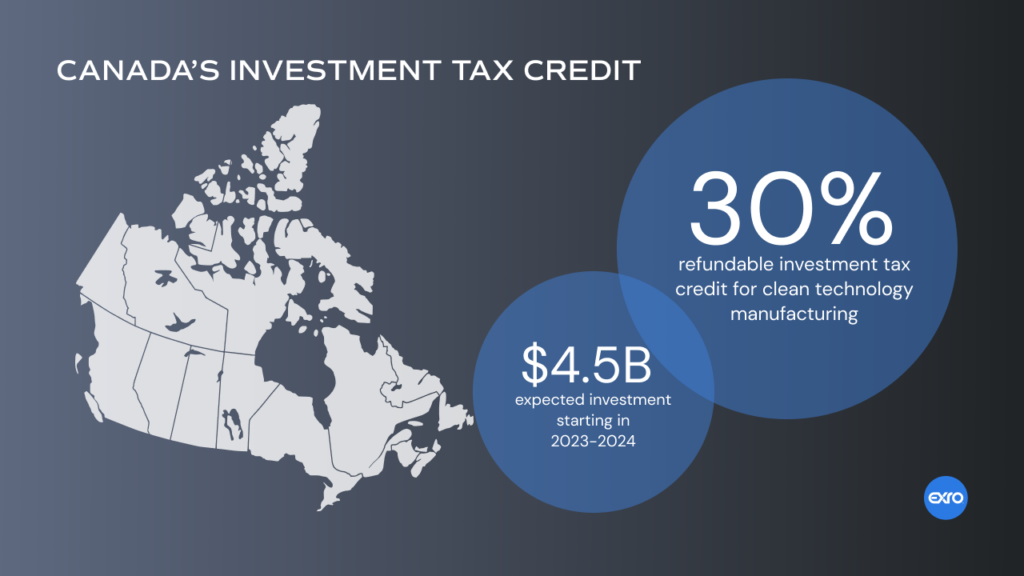
The Clean Technology ITC is a federal refundable tax credit that allows eligible corporations to claim up to 30% of the capital cost of qualifying clean technology property—including solar PV—placed in service after March 27, 2023 and before 2034.
At a high level:
- The credit is refundable, meaning you can receive the benefit even if you don’t have enough tax payable in that first year.
- Eligible property includes solar modules, inverters, and other clean technology equipment as defined in the legislation and technical guidance.
- The full 30% rate is available for many years in the current policy framework, with a planned phase-down near the end of the program.
For a $1,000,000 commercially installed solar plant that qualifies, the CT ITC alone can offset up to $300,000 of capex on paper.
MAG Solar works alongside your tax advisors to structure projects so that you can actually capture as much of that credit as possible and document the equipment and costs correctly.
Accelerated Capital Cost Allowance (CCA) – Classes 43.1 and 43.2
Solar PV equipment typically qualifies for accelerated CCA under Class 43.1 and Class 43.2, which allow higher depreciation rates than standard building assets.
On top of that, the Accelerated Investment Incentive provides an enhanced first-year allowance for eligible property by:
- Suspending the half-year rule, and
- Allowing up to 1.5× the standard CCA rate to be applied to net additions in the first year.
In practical terms, this means you can claim a much larger depreciation deduction in year one than under “normal” rules, which significantly reduces taxable income and improves project cash flow.
MAG Solar doesn’t replace your accountant, but we do model how accelerated CCA and the CT ITC interact in real cash flows, so your finance team can see what this looks like on an after-tax basis.
Provincial and utility programs
Federal incentives are the foundation. On top of that, each province and utility can add its own flavour.
Two of the key markets for MAG Solar—Alberta and BC—have particularly important structures and programs.
☀️Alberta: Commercial solar in a net-billing, Solar Club, and CEIP world
Net billing and micro-generation
In Alberta, most behind-the-meter commercial solar sites participate in micro-generation or small-scale generation programs. Under net billing, you:
- Use your own solar production on-site, offsetting energy charges
- Export surplus energy to the grid and receive credits based on your retailer rate, generally in the $0.05–$0.15/kWh range depending on the contract and market conditions
For many commercial buildings, particularly those with strong daytime loads, most of the energy is consumed internally where it displaces full retail costs.
Solar Club: “Buy low, sell high” for smaller sites
For eligible small micro-generation sites (capacity typically under 150 kW), Alberta’s Solar Club™ programs allow customers to switch between:
- A high rate (recently around 30–33 cents/kWh) when exporting surplus power, usually in the sunnier months.
- A low rate (around 8–9 cents/kWh) when primarily importing energy in winter.
Both imports and exports use the selected rate during each billing period, which lets you “buy low and sell high” across the year if your production profile supports it.
MAG Solar evaluates whether Solar Club participation makes sense for your specific system size, load profile, and retailer, and then designs your array and operating strategy around those realities.
Clean Energy Improvement Program (CEIP)
The Clean Energy Improvement Program (CEIP) is Alberta’s version of PACE financing, allowing municipalities to offer long-term financing for energy upgrades, repaid via the property tax bill.
For commercial properties in participating municipalities, CEIP can:
- Finance up to 100% of project costs in many cases
- Provide long repayment terms (often up to 20–25 years)
- Attach repayment to the property rather than the original owner
For some building owners—particularly those with longer hold periods or who want to reduce up-front capital strain—CEIP can be a powerful way to implement a MAG Solar project while remaining cash-flow positive.
☀️British Columbia: Self-generation, net metering, and load displacement
BC’s policy landscape is different, but also very solar-friendly if approached correctly.
Self-generation / net metering
BC Hydro’s Self-Generation program (formerly called Net Metering) allows customers to:
- Generate their own power on-site
- Offset their consumption with solar
- Export surplus energy back to the grid and receive kWh credits, typically up to certain capacity limits
For smaller commercial systems, you can effectively “bank” excess energy and use it later via credits. For larger systems, export caps or limitations on how much generation can be credited mean it’s critical to size the array intelligently relative to your actual load.
BC Hydro Load Displacement Program
For large commercial and industrial customers, the BC Hydro Load Displacement Program can be a major additional lever. This program:
- Provides non-repayable funding (not a loan)
- Can cover up to 75% of project costs, up to a cap (often around $1 million per project)
- Is specifically designed to encourage behind-the-meter generation that reduces imported energy
In other words, for the right BC customers, the combination of federal incentives, BC Hydro credits, and load displacement funding can make solar one of the highest-ROI projects available on their site.
MAG Solar works with large BC clients to model these programs side by side, ensuring the solar design fits the program rules and your operational needs.
🔀 Commercial solar ROI: how MAG Solar models returns
From the perspective of a CFO, controller, or asset manager, the key questions are straightforward:
- How much do we invest?
- What do we get back, and over what time frame?
- How does this compare to other uses of capital?
To answer those, MAG Solar typically models multiple financial metrics.
Simple payback
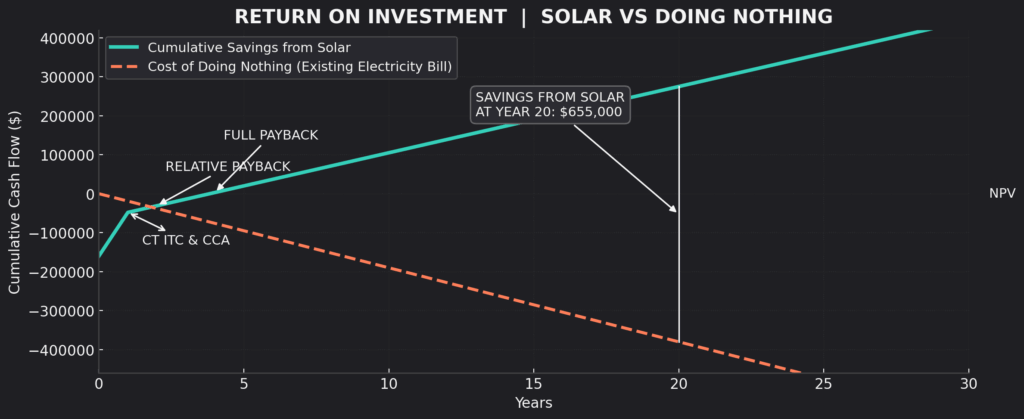
Simple payback looks at the year when cumulative after-incentive savings equal the net installed cost.
For many commercial projects in Alberta and BC, typical simple paybacks fall into the 5–10 year range, with stronger incentive stacks and higher energy rates pulling that number down. Truly exceptional sites (perfect roofs + high rates + strong incentives) can do better; more challenging sites may be a bit longer.
Relative payback vs. “do nothing”
We also look at relative payback: how long it takes for the project’s cumulative cash flow to exceed the cost of simply continuing to buy all of your power from the grid.
This reframes solar as a hedge against rising energy prices—a particularly important perspective when electricity costs have historically trended upward, often 2–5% per year or more in many markets.
Internal Rate of Return (IRR)
IRR expresses the project’s return as an annual percentage. With the CT ITC, accelerated CCA, and the right site conditions, commercial solar projects frequently land in low- to mid-teens IRR territory on an after-tax basis.
For many businesses, that’s competitive with, or better than, other available cap-ex projects—especially when you factor in the risk profile and ESG benefits.
Net Present Value (NPV) and cost of capital
NPV discounts all future cash flows back to today using your chosen discount rate (cost of capital). A positive NPV means the project is expected to create value above your hurdle rate.
For example, a building owner with a 7–9% required return may find that a MAG Solar project produces a substantial positive NPV over a 25–30 year horizon, even after conservative assumptions on energy escalation and O&M.
Levelized Cost of Energy (LCOE)
LCOE answers the question:
“What does each kWh from this array cost us over its lifetime?”
By spreading capital and operating costs over total projected production, you can compare your solar LCOE to:
- Current and projected grid prices
- Internal benchmarks for other energy investments
- Marginal cost of other on-site generation options
If your LCOE is significantly below what you expect to pay the utility long-term, the business case becomes very compelling.

🏦 How commercial solar affects building value and ESG
For real estate owners, institutional investors, and ESG-driven companies, the value of commercial solar goes beyond just cheaper power.
Building valuation and yield on cost
Because solar reduces operating expenses (and in some structures can even generate revenue from exports or roof leases), it directly impacts Net Operating Income (NOI).
Since income-producing property is often valued as:
Value = NOI ÷ Cap Rate
every $1 of sustained annual savings can translate into $10–$20 or more in asset value depending on the cap rate.
MAG Solar often works with landlords and asset managers to present solar not just as an energy project, but as a property value strategy, showing yield on cost, NOI uplift, and the impact on valuation.
ESG reporting, brand, and stakeholder expectations
On the ESG side, commercial solar is unusually powerful because:
- Emissions reductions from displaced grid electricity are quantifiable and auditable.
- Sustainability-minded tenants and customers can clearly see the investment on the building.
- Investors and lenders increasingly favour assets with visible, credible decarbonization measures.
MAG Solar helps clients quantify annual and lifetime CO₂e reductions, which can feed directly into ESG reports, investor decks, and sustainability communications.
👷 MAG Solar’s process for commercial projects
Because commercial solar touches engineering, finance, incentives, and operations, our process at MAG Solar is intentionally structured and transparent.

Step 1 – Discovery and data collection
We start with:
- 12–36 months of interval or billing data (where available)
- Recent utility bills and tariff details
- Roof drawings or satellite imagery
- Basic information about your business, operating hours, and goals
From here, we develop a high-level feasibility scan, so you’re not guessing whether the project is even worth deeper analysis.
Step 2 – Preliminary design and capacity study
Our design team builds an initial layout:
- Array size and orientation based on roof or land constraints
- Preliminary production estimates using bankable solar modelling tools
- Early thoughts on structural and electrical considerations
This gives you a first look at what’s physically possible.
Step 3 – Incentive and financial modelling
We then layer in:
- CT ITC eligibility for your corporate structure and project timing
- Accelerated CCA treatment and the accelerated investment incentive
- Provincial programs such as Solar Club, BC Hydro Self-Generation, BC Hydro Load Displacement, and CEIP where applicable
We model multiple scenarios (e.g. different system sizes, cash vs financing options) so your finance team can compare payback, IRR, NPV, and cash-flow profiles side by side.
Step 4 – Detailed engineering and interconnection
Once you approve a direction, MAG Solar proceeds with:
- Independent structural engineering sign-off and any required upgrades
- Detailed electrical design and protective device coordination
- Utility interconnection applications and any required studies
- Final equipment selection (modules, inverters, racking, monitoring)
Our electrical and structural engineers work together so that the design is not only efficient, but fully compliant with code and utility requirements.
Step 5 – Construction, commissioning, and training
During construction, our project managers coordinate:
- Site access, cranes, and safety equipment
- Roof protection and sequencing to minimize disruption to operations
- Installation of racking, modules, wiring, and switchgear
- Testing, commissioning, and utility witness (where required)
We then walk your team through:
- System operation basics
- Monitoring portals and reporting
- What to expect on your first few utility bills
Step 6 – Ongoing performance and support
Commercial solar is a 25+ year asset. MAG Solar provides:
- Performance monitoring and alerting
- Support in interpreting production data vs. expectations
- Guidance when tariff structures, incentives, or operational needs change
Our goal is not just to install a plant, but to ensure that it continues producing the financial and sustainability outcomes you modelled at the start.
🌿 Is Commercial Solar Right for Your Building?
Not every building will be a slam-dunk, but many more are viable than owners realize. Commercial solar with MAG Solar tends to make the most sense when a variety of factors are met.
Considering:
🌎 You want to improve NOI, long-term cost stability, and ESG profile
💡 Your building has meaningful daytime electricity usage
🏢 You have a reasonable amount of usable roof or land area
🛠️ You’re prepared to take advantage of federal incentives and accelerated CCA with the help of your tax advisors
💚 You plan to hold the asset for at least part of the system life
For other buildings—particularly those with extremely constrained roofs, very low loads, or complex ownership and utility situations—the numbers may be weaker, and we’ll be upfront about that.
📞 Next steps: model your own commercial solar business case with MAG Solar
If you’re reading this as a business owner, asset manager, or CFO, you don’t need more generic hype—you need numbers. Here’s what working with MAG Solar typically looks like in practice:
👉Book a a no-obligation feasibility assessment with a preliminary design and financial model
👉 You share basic building and utility data.
👉 Together with your finance and tax advisors, we refine the design around your capital structure, incentives, and risk tolerance.
👉 If the project meets your hurdle rates, we move into full engineering and delivery.
📋 Commercial solar is one of the rare investments that can:
✅ Cut operating expenses
✅ Improve asset value and ESG scores
✅ Reduce exposure to rising energy prices
✅ Provide long-lived, predictable performance
If you’d like to see what that could look like for your specific building or portfolio in Alberta, BC, or elsewhere in Canada, reach out to MAG Solar for a tailored commercial solar assessment and ROI model.
- Let's Connect
Get a Free Commercial Solar Assessment
See How Much you Can Save with Solar. Get your Free Design & Consultation
FAQ – SEO Question & Answer
Q: How much do commercial solar panels cost in Canada, and what kind of ROI and payback can my business expect with MAG Solar?
A: The cost of commercial solar panels in Canada depends on system size, roof/land conditions, and electrical complexity, but most professionally engineered projects fall into a predictable range when priced in dollars per watt ($/W).
As a rough guide in 2025–2026:
-
Smaller commercial or agricultural systems (<100 kW) often land around $1.70–$2.00 per watt installed.
-
Mid-sized systems (100–500 kW)—for warehouses, retail, offices, and farms—typically fall in the $1.60–$1.90 per watt range.
-
Larger systems (500 kW–1 MW+) on clean, open roofs can come down into the $1.30–$1.50 per watt range, or sometimes lower for multi-megawatt projects with strong economies of scale.
For example, a 250 kW rooftop array at $1.75/W would have a gross installed cost of about $437,500, while a 1 MW system at $1.35/W would be around $1,350,000 before incentives. Actual pricing will always depend on your roof condition, structure, location, and interconnection requirements, which is why MAG Solar starts every project with a custom engineering and financial assessment rather than a generic “per kW” quote.
The more important question for most decision-makers is ROI and payback. In Canada, commercial solar benefits from powerful federal incentives such as the Clean Technology Investment Tax Credit (CT ITC)—a refundable tax credit of up to 30% of eligible solar costs for qualifying corporations—and accelerated depreciation under Capital Cost Allowance (CCA) Classes 43.1/43.2, which allow you to write off a large portion of the system value in the first few years. Stacked correctly with provincial and utility programs (for example, Solar Club and CEIP in Alberta, or BC Hydro’s self-generation and load displacement options in BC), these incentives can significantly reduce the net cost of your solar project.
When we model projects for clients at MAG Solar, we frequently see:
-
Simple payback periods in the 5–10 year range, depending on power rates, site conditions, and incentive eligibility.
-
Internal Rates of Return (IRR) in the low- to mid-teens on an after-tax basis for well-sited projects.
-
Positive Net Present Value (NPV) over a 25–30 year system life when using reasonable assumptions for energy price escalation and maintenance.
For many buildings, that means a commercial solar array will pay for itself in the first third or so of its warrantied life, and then continue producing low-cost electricity and operating savings for the remaining years. On top of the direct financial return, solar can boost Net Operating Income (NOI) by reducing utility expenses, improve property value, and provide clear, auditable emissions reductions for ESG reporting.
Because every roof, tariff, and corporate tax situation is different, MAG Solar always builds a custom ROI and payback model for your specific site. We incorporate your real consumption data, current and projected energy rates, applicable incentives, and your accountant’s preferred assumptions so you can compare solar directly to other capital projects and make a confident, numbers-driven decision.
If you’d like to see what commercial solar would cost on your building—and what payback and ROI you could expect—MAG Solar can provide a tailored feasibility study and financial model based on your actual utility data and roof layout.
Commercial solar incentives in Canada can reduce the total cost of a solar project by 30% or more through refundable tax credits, capital cost deductions, and sometimes even provincial rebates. These savings improve your return on investment and shorten the payback period of commercial solar installations.
Eligible businesses include:
-
Taxable Canadian corporations
-
Commercial landlords and developers
-
Real Estate Investment Trusts (REITs)
-
Partnerships where all members are eligible corporations
As long as your project is in Canada and involves new, qualifying clean energy equipment, you may be able to access commercial solar incentives in Canada.
Yes — solar panels are one of the main technologies supported under commercial solar incentives in Canada. Both grid-tied and off-grid solar PV systems, solar heating, and concentrated solar equipment can qualify for the CT ITC and accelerated capital cost deductions.
Absolutely. You can combine:
-
The CT ITC (30% refundable tax credit)
-
The Accelerated Investment Incentive (AII)
-
The Accelerated Capital Cost Allowance under Class 43.1 or 43.2
-
Provincial solar rebates (where available) Stacking these commercial solar incentives in Canada can reduce your net project cost by 50% or more.
The CT ITC is one of the key commercial solar incentives in Canada, offering a refundable tax credit of up to 30% for eligible solar projects. This applies to solar panels, energy storage systems, and other clean technology assets used in commercial or industrial operations across Canada.
The Accelerated Investment Incentive is another powerful tool within the suite of commercial solar incentives in Canada. It lets businesses deduct up to 3 times the normal depreciation in the first year for eligible solar equipment. This improves short-term cash flow and makes commercial solar more affordable.
Yes. Businesses can stack the CT ITC with:
-
Accelerated Capital Cost Allowance (ACCA) under Classes 43.1 and 43.2
-
The Accelerated Investment Incentive (AII)
-
Provincial rebates or net metering programs
Stacking incentives can dramatically reduce your net project costs and improve ROI.
Commercial solar systems are relatively low-maintenance. There are no moving parts in the panels themselves, and routine work typically involves:
-
Periodic visual inspections of wiring, racking, and roof penetrations
-
Monitoring system performance through the online portal
-
Occasional cleaning in dusty or heavily soiled locations
MAG Solar designs systems with remote monitoring, so under-performance or faults can be detected quickly. Many businesses choose a simple annual or bi-annual maintenance plan to keep their array operating at peak efficiency and protect their long-term ROI.
The size of a commercial solar system in Canada depends on your annual electricity usage, your roof or land area, and your budget and ROI targets. Some businesses only want to offset a portion of their usage with a 100–200 kW system, while large warehouses or industrial facilities may install 500 kW to several megawatts of solar. At MAG Solar, we start with your 12-month utility history and roof layout, then design a system that balances energy offset, payback period, and capital cost so the array actually fits your building and your business goals.
A commercial solar project in Canada typically takes 4–9 months from initial assessment to final commissioning, depending on size and complexity. The on-site construction phase is usually only a few weeks; most of the time is spent on feasibility studies, engineering, utility approvals, permitting, and procurement. MAG Solar manages this process end-to-end: we handle your engineering, drawings, interconnection applications, and inspections so that your internal team doesn’t have to coordinate multiple contractors.
Most rooftop solar projects can be built with minimal disruption to normal operations. Crews work primarily on the roof and in electrical rooms, and any required shutdowns to tie into your service are usually scheduled during off-hours or low-impact windows. MAG Solar coordinates installation around your production schedule, safety protocols, and access requirements so your team can keep running the business while the system is being installed.
Yes, but roof condition is an important part of the financial decision. If your commercial roof is near the end of its life, it may make more sense to re-roof before or alongside the solar installation, so you don’t have to remove and reinstall the array later. MAG Solar can work with your roofing contractor to plan a combined project, and we can also assess whether a ground-mounted system is a better fit if the roof is not suitable. During feasibility, we’ll be honest about whether it’s smarter to wait, re-roof first, or move ahead immediately.
In most cases in Canada, rooftop commercial solar arrays are treated as part of the building’s fixed assets. That means they’re included in property insurance (with updated limits) and are recognized in financing and appraisal discussions. Lenders and investors increasingly understand commercial solar as an income-enhancing infrastructure upgrade—especially when MAG Solar provides supporting documentation on capital cost, expected savings, and system warranties for underwriting and valuation.