🧑🌾 Solar for Farms in Canada: Agricultural Solar Power, Incentives & ROI (2026 Guide)
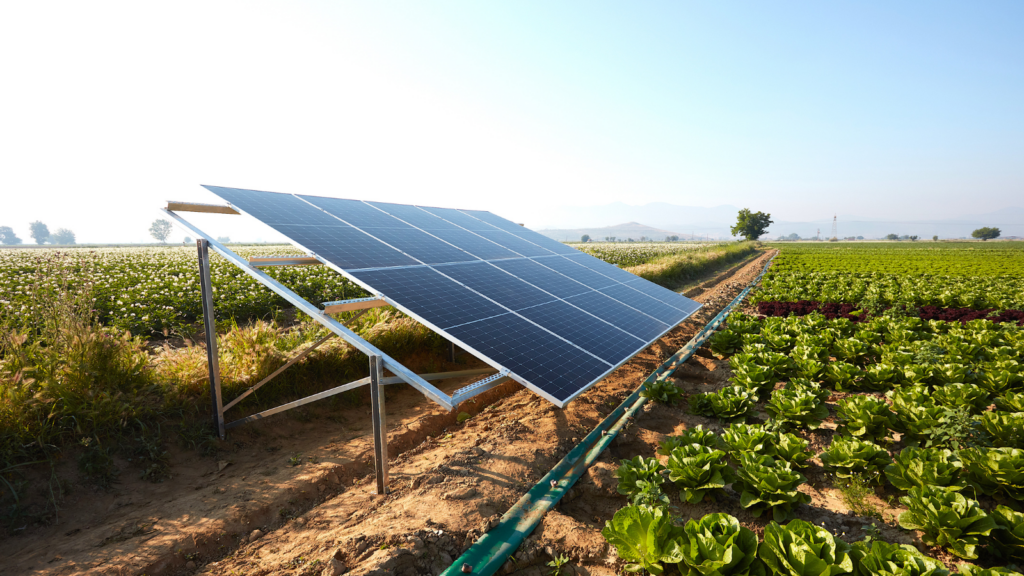
Across Canada, more producers are turning to solar for farms to power barns, irrigation systems, grain handling, and on-farm processing. Agricultural solar power isn’t just about “going green” anymore; it’s about stabilizing one of your most important inputs: electricity.
Whether you run a grain farm on the Prairies by Winnipeg, a dairy farm in BC, or a mixed operation in Alberta, a properly designed farm solar energy system can:
- ⚡ Offset a large share of your hydro bill
- 📈 Protect your operation from long-term electricity price increases
- 🍁 Qualify for powerful federal clean-technology incentives
- 🧑🌾 Reduce your farm’s carbon footprint and support ESG or sustainability goals
But if you're thinking about installing Agricultural Solar here are the important questions:
This guide explains how solar panels for farms work in Canada, what they cost, how incentives like the Clean Technology Investment Tax Credit (CT ITC) and Agricultural Clean Technology (ACT) Program can shrink the net cost, and how MAG Solar designs and delivers agricultural PV systems.
🐄 Why Farms are Ideal for Solar Power
Farms have a few big advantages over typical residential properties when it comes to solar power for agriculture:
Advantages:
☀️ Plenty of roof space on barns, machine sheds, shops, and storage buildings
🏔️ Available land for ground-mount or agrivoltaic systems
💡 High daytime power use from fans, pumps, refrigeration, milking equipment, and grain handling
🧠 A long-term mindset: many producers think in decades, not just the next couple of years
Typical on-farm loads that match well with agricultural solar energy include:
- 🐮 Dairy barns (milking systems, vacuum pumps, bulk tanks, fans)
- 🐔 Poultry and livestock barns (ventilation, heating support, lighting, feeding systems)
- 🚿 Irrigation pumps and pivot systems
- 🌾 Grain drying and aeration fans
- 🔨 Workshops and machine sheds (welders, compressors, tools)
- 🧑🌾 On-farm processing (packing lines, washing, refrigeration)
Because most of these loads run during or around daylight hours, a grid-tied solar system for farms can offset a big portion of usage without much wasted export.
💰 How Much Does Agricultural Solar Cost?
Just like commercial solar, farm solar systems are usually priced in dollars per watt ($/W) of installed capacity. That makes it easy to compare systems of different sizes.
Typical turn-key installed cost ranges in 2025–2026 for solar panels on farms:
Smaller farm solar systems (10–50 kW)
Often around $2.00–$2.40/W for barn-roof or shop-roof systems, depending on location and complexity.
Mid-sized agricultural solar arrays (50–150 kW)
Commonly $1.80–$2.20/W, especially when built on large, open metal roofs.
Larger farm and agri-business systems (150–500 kW)
Sometimes in the $1.70–$2.10/W range on very clean roofs or ground-mount sites.
Very large systems (1–5 MW+)
With strong economies of scale, some projects can land in the $1.20–$1.40/W range, especially on big, simple roofs or ground-mounts.
For example:
A 1 MW system at $1.35/W would be ~$1,350,000 before any incentives.
🧑🌾 Actual pricing for Agricultural Solar depends on:
- Roof type and condition (steel, shingle, membrane)
- Whether it’s roof-mount vs. ground-mount solar for farms
- Distance to electrical service and trenching needs
- Utility requirements and interconnection costs
- Site access (yard layout, grain bins, bins/augers in the way, etc.)
MAG Solar doesn’t just throw out a generic price per kW. We design agricultural solar PV systems around your actual load profile, yard layout, and farm finances so the system size and cost make sense for your operation.
☀️ Types of Agricultural Solar Systems:
There’s no one “right” way to deploy solar for agriculture.
MAG Solar typically works with three main configurations:
Barn and shed roof-mount solar
This is the most common form of solar panels for barns:
Uses existing metal or shingle roofs on machine sheds, dairy barns, poultry barns, or commodity sheds
Keeps wiring short and close to the main farm service
Preserves land for crops and grazing
Well-oriented roofs (south, southeast, southwest) perform best, but east–west roofs can still be excellent, especially for grid-tied farm solar systems where all energy offsets electric bills.
Ground-mount solar arrays for farms
When roof area is limited or roofs are nearing replacement, ground-mounted farm solar can be a better fit:
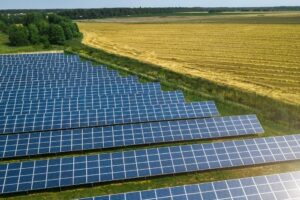
Flexible orientation and tilt for maximum output
Easy to expand in phases as your farm grows
Excellent for irrigation solar, where you want the array near pumps or pivots
Ground mounts are ideal in yards with unused corners, old corrals, or marginal land that isn’t productive.
Agrivoltaics (solar + crops / grazing)
Agrivoltaics combines solar panels on farmland with ongoing agricultural use:
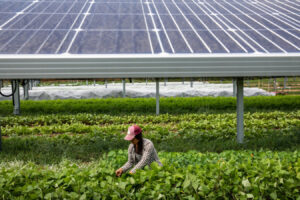
Higher racking that allows sheep grazing under and around arrays
Rows spaced to allow machinery passes or specialized crops
Partial shade that can help certain crops in hot, dry regions
Agrivoltaics is still emerging in Canada, but early projects show strong potential for dual-use solar farms where land is at a premium.
🏦 Incentives for Solar on Farms in Canada
Where solar for farms in Canada really stands out is the incentive stack. Producers can often access:
- Federal Clean Technology Investment Tax Credit (CT ITC)
- Accelerated Capital Cost Allowance (CCA) classes 43.1 and 43.2
- The Agricultural Clean Technology (ACT) Program – Adoption Stream
- Provincial and utility programs (BC Hydro self-generation, SaskPower net metering, Efficiency Manitoba, etc.)
🍁 Federal Incentives: Shrinking the Net cost of Agricultural Solar
Where agricultural solar really becomes compelling in Canada is in the incentive stack. You’re not just installing a system; you’re also unlocking significant tax benefits.
Clean Technology Investment Tax Credit (CT ITC)
The CT ITC is a federal refundable tax credit for capital invested in eligible clean-technology property, including solar PV. For property acquired and available for use between March 28, 2023 and the end of 2033, the credit can be up to 30% of the capital cost; for 2034 it drops to 15% before phasing out.
Key points for farms:
- It’s available to taxable Canadian corporations and similar entities; non-corporate farms may not qualify directly.
- Eligible property includes solar PV, inverters and related clean-energy equipment that meets the technical definitions.
- The credit is refundable, meaning you can receive a cash refund if the credit exceeds your corporate tax payable.
For a 100 kW farm solar array with a $190,000 installed cost, a 30% CT ITC could be worth up to $57,000, dramatically lowering your net investment.
Accelerated Capital Cost Allowance (CCA) – Classes 43.1 and 43.2
Solar PV used to generate renewable electricity for income typically qualifies for accelerated CCA under Class 43.1 (30% declining-balance) or Class 43.2 (50%), depending on acquisition date and details.
On top of that, the Accelerated Investment Incentive allows an enhanced first-year deduction (“full expensing”) for eligible clean-energy equipment acquired after November 20, 2018 and available for use before 2028.
In plain language: you can write off a large chunk of the system value in the first few years, increasing cash flow and improving ROI on your farm solar power investment.
🌽 Agricultural Clean Technology (ACT) Program
The federal Agricultural Clean Technology Program – Adoption Stream provides non-repayable contributions to help farmers purchase and install commercially available clean technologies that reduce greenhouse gas emissions.
- It focuses on projects that deliver measurable emission reductions in areas such as green energy, energy efficiency, and precision agriculture.
- Funding levels and eligibility criteria change by intake, but grants can be significant for qualifying projects.
Solar for farms can fit into ACT when it clearly reduces on-farm fossil energy use and GHG emissions. MAG Solar tracks ACT updates and will flag when your project looks like a strong candidate so you can talk strategy with your ag advisor or consultant.
🧑🌾 Agricultural Clean Technology (ACT) Program – Adoption Stream
One of the most important pieces of the puzzle for farms investing in solar is the Agricultural Clean Technology (ACT) Program, delivered by Agriculture and Agri-Food Canada (AAFC). The ACT Program is part of Canada’s broader climate plan and is designed to help the agriculture sector shift toward lower greenhouse gas (GHG) emissions while staying productive and competitive.
The program has two main parts:
- Research and Innovation (R&I) Stream – for pre-market R&D, pilots, and demonstration projects
- Adoption Stream – for farms and agri-businesses that want to purchase and install commercially available clean technologies
For solar on farms, the Adoption Stream is usually the one that matters most.
What the ACT Adoption Stream actually does
The ACT – Adoption Stream provides non-repayable contributions (grant-style funding) to help producers and agri-food businesses adopt proven clean technologies. The goal is simple: fund projects that reduce GHG, fertilizer, and methane emissions on real farms and in processing facilities.
Projects must fit into at least one of three priority areas:
- Green energy and energy efficiency
- Technologies that power farms with cleaner energy or help manage energy-intensive processes more efficiently.
- Examples AAFC specifically calls out include more efficient grain dryers, fuel switching (e.g., away from diesel), and renewable systems like solar and solar-powered equipment.
- Precision agriculture
- Technologies that reduce input use (fertilizer, fuel, etc.) by applying them more precisely. Think GPS-guided systems, nutrient management tech, and data-driven tools.
- Bioeconomy solutions
- Systems that turn agricultural waste (like manure or crop residues) into energy or bio-products—examples include anaerobic digesters and biomass boilers.
- Systems that turn agricultural waste (like manure or crop residues) into energy or bio-products—examples include anaerobic digesters and biomass boilers.
Solar for farms typically falls under “green energy and energy efficiency” when it can demonstrate real, measurable reductions in emissions compared to your current setup.
How much ACT funding can a farm get?
Exact numbers can change from intake to intake, but recent rounds of the ACT Adoption Stream have generally offered:
- Non-repayable funding that can cover up to ~40–50% of eligible project costs for for-profit recipients
- Higher cost-share (up to ~75%) for some not-for-profit applicants in certain cases
- Funding ranges from a minimum project size (often tens of thousands) up to a maximum of about $2 million per project, and caps per recipient (for example, totals up to $5 million across multiple projects in some program guides).
In plain language, for a qualifying farm solar project:
- If you had a $250,000 solar + efficiency project, ACT Adoption could potentially fund a six-figure portion of that total, with you providing the remaining cost share.
- If your project is smaller, ACT has historically had a minimum eligible cost threshold, so micro-systems may not be a good fit, but mid-scale and larger projects absolutely can be.
Because every intake has its own guide, MAG Solar treats these numbers as illustrative ranges, not promises—when we scope a project, we look at the current ACT intake and match your project to the latest rules.
Who is eligible under ACT Adoption?
Eligibility is defined pretty clearly by AAFC. Recent program guides describe eligible applicants to the Adoption Stream as:
- For-profit organizations (including farm corporations and agri-food processors)
- Individuals or sole proprietors (i.e., unincorporated farmers)
- Co-operatives and partnerships
- Indigenous groups and businesses
To qualify, you typically must:
- Be a Canadian entity or incorporated in Canada
- Be a legal entity capable of signing a contribution agreement
- Have your share of the project funding secured before applying (ACT is cost-shared, not 100% free money)
- Submit only one application to the Adoption Stream for the life of the program (including subsidiaries)
- Propose a project that clearly fits within one of the priority areas and delivers measurable emissions reductions
Financial institutions, universities, and federal Crown corporations are usually not eligible as recipients under Adoption.
What makes a good “solar for farms” project for ACT?
ACT isn’t just “solar rebate money.” The program is highly focused on measurable emission reductions. For solar projects, that usually means:
- You’re replacing a meaningful amount of grid electricity or fossil-fuel-based power with on-farm solar generation
- You can show how much electricity the system will produce annually and what emissions it displaces (MAG Solar can model this)
- If your farm currently relies heavily on diesel or propane for certain loads (irrigation, pumping, drying), and solar + electrification reduces that, the emissions story becomes even stronger
Projects that tend to look good on paper for ACT:
- Barn or dairy solar systems that offset large, steady electrical loads
- Irrigation solar for farms, where PV displaces grid or diesel pumping
- Solar plus efficiency upgrades, like combining a solar array with high-efficiency fans, pumps, or heating systems, and clearly documenting the total emissions impact
- Integrated projects where solar is part of a broader GHG reduction strategy on the farm
Projects that are purely “we want solar because it’s trendy,” without a clear emissions and baseline story, are less likely to stand out.
How ACT fits with other incentives (CT ITC, CCA, etc.)
This is where a good accountant and a good solar partner matter.
In broad terms:
- ACT provides a non-repayable contribution toward your eligible project costs.
- CT ITC (Clean Technology Investment Tax Credit) and accelerated CCA provide tax benefits on the capital you actually end up investing.
However, different programs sometimes have rules about “stacking” (using multiple funding sources on the same cost). You may:
- Be allowed to stack ACT contributions with other federal or provincial programs up to a maximum percentage
- Need to calculate CT ITC on your net cost after grants, not on the portion paid by other governments
MAG Solar doesn’t replace your tax advisor, but we can:
- Flag where ACT + CT ITC + CCA might all be in play
- Provide the detailed cost breakdowns and project documentation your accountant needs
Adjust the system size or project phasing so that your cost-share and stacking line up with current program rules
ACT program timing and why it matters for planning
A key nuance: ACT is not always open. It runs in intakes, which:
- Open for a period
- Accept applications
- Close once the window or available funding is exhausted
For example, recent rounds of the Adoption Stream have closed to new applications while AAFC processes existing projects, with indications that future intakes may reopen under updated terms.
That means two things for your blog (and for your farm):
- The program is important enough to know about, but you shouldn’t promise that funding is guaranteed or always available.
- There’s a real advantage in having a shovel-ready solar project (design, cost, emissions numbers) when a new intake opens, instead of scrambling while everyone else is applying.
How MAG Solar handles ACT for farm solar projects
Because the ACT Adoption Stream is such a powerful lever for solar for farms in Canada, we treat it as a strategic layer in ag projects rather than an afterthought.
When we see a farm that could be a strong fit, MAG Solar will:
- Flag that your project looks ACT-aligned (green energy / energy efficiency with measurable GHG reductions)
- Build production + emissions reduction estimates into your proposal, which can be used in an ACT application
- Coordinate with your ag advisor, grant consultant, or accountant so the financials and narrative match what the program is looking for
- Keep an eye on new intake announcements and policy changes, and let you know if there’s a window that aligns with your project timeline
ACT doesn’t fund every farm, and it doesn’t run forever—but when it lines up with the right project, it can dramatically reduce the net cost of a farm solar system and turn a “nice idea someday” into a financially compelling investment right now.
🍁 Provincial and utility programs for farm solar
Depending on where your farm is located, you may also benefit from utility-specific programs:
- BC Hydro Self-Generation (Net Metering) – for farms in BC, this program allows you to generate renewable electricity (e.g., solar), use it on site, and receive credits for excess exported energy, up to program caps. British Columbia also has a generous rebate program through BC Hydro.
- SaskPower Net Metering – farms and rural customers can install renewable generation up to a defined capacity, exporting surplus power with credits applied to the bill.
- Efficiency Manitoba Solar Rebate & Net Billing – farms in Manitoba can receive per-watt solar rebates and export surplus energy under net-billing rules.
- Alberta – While province-wide rebates come and go, farms benefit from strong solar resources and can participate in net-billing/self-generation programs; they may also be eligible for local CEIP (PACE-style) financing where available.
Because these programs change frequently, MAG Solar treats provincial/utility incentives as a living layer in every proposal rather than relying on outdated lists.
🧑🌾 Design Considerations: Getting Agricultural Solar Right
Designing a solar energy system for a farm is not the same as doing a residential rooftop.
MAG Solar pays attention to farm-specific details:
Load analysis and rate structure
We start by pulling 12–24 months of farm electricity data:
- kWh usage averages and peaks
- Demand charges (where applicable)
- Seasonal patterns (irrigation, grain drying, winter barn loads)
- Tariff structure (time-of-use, flat rate, demand components)
This helps us size the farm solar array to offset the right portion of your consumption, avoiding oversizing that just dumps energy to the grid at a lower export rate.
Roof condition and remaining life
Before we install solar panels on barn roofs, we look at:
- Age and condition of roofing
- Fastener integrity and possible corrosion
- Any planned re-roofing or expansion in the near future
If the roof is near end-of-life, it can be smarter to re-roof before solar so you’re not pulling the array off mid-life.
Structural capacity and snow loads
Canadian farms deal with real winters. Our structural engineers:
- Check truss / rafter spacing and load ratings
- Model additional dead load from panels and racking, plus snow and wind loads
- Make sure solar mounting on farm buildings doesn’t compromise structure or safety
For ground-mounts, we design foundations or piles that fit your soil conditions and machinery traffic.
Biosecurity and operations
On livestock farms, biosecurity and animal stress matter. MAG Solar coordinates:
- Crew access routes that avoid sensitive areas
- Noise and activity windows that minimize disruption to milking or feeding
- Clean-up so yards return to normal quickly after construction
We also plan installation windows around busy seasons like seeding, calving, and harvest.
☀️Alberta: Agricultural solar in a net-billing, Solar Club, and CEIP world
Net billing and micro-generation
In Alberta, most behind-the-meter solar for farms sites participate in micro-generation or small-scale generation programs. Under net billing, you:
- Use your own solar production on-site, offsetting energy charges
- Export surplus energy to the grid and receive credits based on your retailer rate, generally in the $0.05–$0.15/kWh range depending on the contract and market conditions
For many farms, particularly those with strong daytime loads, most of the energy is consumed internally where it displaces full retail costs.
Solar Club: “Buy low, sell high” for smaller sites
For eligible small micro-generation sites (capacity typically under 150 kW), Alberta’s Solar Club™ programs allow customers to switch between:
- A high rate (recently around 30–33 cents/kWh) when exporting surplus power, usually in the sunnier months.
- A low rate (around 8–9 cents/kWh) when primarily importing energy in winter.
Both imports and exports use the selected rate during each billing period, which lets you “buy low and sell high” across the year if your production profile supports it.
MAG Solar evaluates whether Solar Club participation makes sense for your specific system size, load profile, and retailer, and then designs your array and operating strategy around those realities.
Clean Energy Improvement Program (CEIP)
The Clean Energy Improvement Program (CEIP) is Alberta’s version of PACE financing, allowing municipalities to offer long-term financing for energy upgrades, repaid via the property tax bill.
For large volume farms, in participating municipalities, CEIP can:
- Finance up to 100% of project costs in many cases
- Provide long repayment terms (often up to 20–25 years)
- Attach repayment to the property rather than the original owner
For some building owners—particularly those with longer hold periods or who want to reduce up-front capital strain—CEIP can be a powerful way to implement a MAG Solar project while remaining cash-flow positive.
☀️British Columbia: Self-generation, net metering, and load displacement
BC’s policy landscape is different, but also very solar-friendly if approached correctly.
Self-generation / net metering
BC Hydro’s Self-Generation program (formerly called Net Metering) allows customers to:
- Generate their own power on-site
- Offset their consumption with solar
- Export surplus energy back to the grid and receive kWh credits, typically up to certain capacity limits
For smaller farm systems, you can effectively “bank” excess energy and use it later via credits. For larger systems, export caps or limitations on how much generation can be credited mean it’s critical to size the array intelligently relative to your actual load.
BC Hydro Load Displacement Program
For large agricultural and industrial customers, the BC Hydro Load Displacement Program can be a major additional lever. This program:
- Provides non-repayable funding (not a loan)
- Can cover up to 75% of project costs, up to a cap (often around $1 million per project)
- Is specifically designed to encourage behind-the-meter generation that reduces imported energy
In other words, for the right BC customers, the combination of federal incentives, BC Hydro credits, and load displacement funding can make solar one of the highest-ROI projects available on their site.
MAG Solar works with large BC clients to model these programs side by side, ensuring the solar design fits the program rules and your operational needs.
🔀 ROI and payback for solar on farms
When installing solar panels on farms, most producers really want to know is: “Does solar pay?”
Simple payback
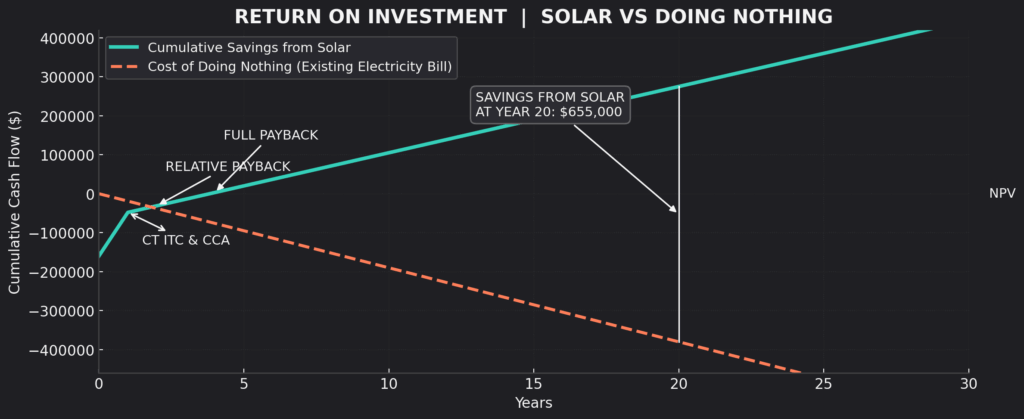
Many solar power systems for farms show simple payback periods in the 8–14 year range before incentives, depending on:
- ⚡ Local electricity rates
- 🔌 System size vs. load
- 🧑🔧 Roof vs. ground mount
- 🪙 Export credit rates
When you layer in CT ITC, accelerated CCA, and any relevant ACT or provincial programs, that payback can shorten significantly—sometimes into single-digit years for well-matched sites.
Internal Rate of Return (IRR) and NPV
We model IRR and Net Present Value for farm solar projects, just as we do for commercial ones:
- CT ITC provides a 30% refundable tax credit on eligible costs for many corporate farm structures.
- Accelerated CCA under classes 43.1 and 43.2 allows rapid write-offs that can be worth tens of thousands in tax savings.
The combination often yields double-digit IRRs and positive NPV over 25–30 years, especially in provinces with higher electricity prices or strong net-metering rules.
Risk, resilience, and succession
For a farm, ROI isn’t only about spreadsheets:
- Solar reduces exposure to long-term rate hikes, increasing financial resilience.
- It can support farm succession planning, as the next generation inherits lower operating costs and a long-lived asset.
👷 MAG Solar’s process for farm solar projects
To keep things practical and farmer-friendly, MAG Solar follows a clear process from first conversation to commissioning.

Step 1 – Farm power profile
We start by collecting:
- 12–24 months of hydro bills for your main meters
- A rough yard map or satellite view
- Notes on major loads (irrigation, grain drying, barns, shops) and any upcoming expansions
From this we build your baseline energy picture.
Step 2 – Site assessment and concept design
Our designers then:
- Identify the best roofs for barn solar panels
- Flag possible ground-mount farm solar locations
- Check shading from bins, trees, and topography
We produce a concept design: proposed system size, layout, annual production estimate, and approximate cost.
Step 3 – Incentive & financial modelling
Next, we layer in all relevant incentives for solar for farms in Canada:
- CT ITC eligibility and timing for your farm corporation
- Accelerated CCA with the Accelerated Investment Incentive
- ACT Program opportunities, if your project fits the current intake priorities
- Provincial/utility rebates and net-metering rules for your location
You receive a farm-specific solar ROI report showing:
- Up-front vs. net cost after incentives
- Simple payback
- Average annual savings and lifetime savings
- IRR and NPV over 25–30 years
This gives you something concrete to review with your accountant, banker, or family.
Step 4 – Detailed engineering & approvals
Once the numbers make sense, we:
- Complete structural engineering on barns/sheds or ground-mount foundations
- Finalize electrical single-line diagrams and protection design
- Submit net-metering / self-generation applications to your utility
- Coordinate any ACT or other funding paperwork with your advisors
You don’t have to spend hours on the phone with utilities or deciphering technical standards—that’s our job.
Step 5 – Construction & commissioning
During construction, MAG Solar:
- Schedules around your busy farming seasons
- Manages safety, roof protection, and yard access
- Installs racking, modules, wiring, and switchgear
- Completes testing, utility witness (where required), and final sign-off
We then walk you through the system, monitoring portal, and what to expect on your first few post-solar bills.
Step 6 – Long-term support & monitoring
Solar is a 25- to 30-year asset. MAG Solar stays in the picture with:
- Production monitoring and performance alerts
- Periodic inspection and maintenance options
Support if utility tariffs or programs change and you need to adapt your strategy
🌿 Is Agricultural Solar Right for Your Farm?
Not every farm will be a home run, but many more are viable than owners realize. Agricultural solar with MAG Solar tends to make the most sense when a variety of factors are met.
Considering:
🌎 You want to improve NOI, long-term cost stability, and ESG profile
🌽 You have a reasonable amount of usable roof or land area
🛠️ You’re prepared to take advantage of federal incentives and accelerated CCA with the help of your tax advisors
💚 You plan to hold the asset for at least part of the system life
For other farms—particularly those with extremely constrained roofs, very low loads, or complex ownership and utility situations—the numbers may be weaker, and we’ll be upfront about that.
📞 Next steps: Explore Solar for your Farm with MAG Solar
If you’re ready to see how solar for your farm could work:
👉Book a a no-obligation feasibility assessment with a preliminary design and financial model
👉 Gather 12 months of power bills for your main farm meters.
👉 Snap a few photos of your barns, sheds, or potential ground-mount areas
👉 If the project meets your hurdle rates, we move into full engineering and delivery.
📋 Agricultural solar is one of the rare investments that can:
✅ Cut operating expenses
✅ Improve asset value and ESG scores
✅ Reduce exposure to rising energy prices
✅ Provide long-lived, predictable performance
We’ll turn that into a custom agricultural solar design, a clear business case, and a step-by-step plan that fits your operation, your land, and your long-term goals.
Solar energy for farms is no longer experimental. With the right partner and the right incentives, it’s a practical way to lower operating costs, stabilize your energy future, and build a more resilient farm for the next generation.
- Let's Connect
Get a Free Agricultural Solar Assessment
See How Much you Can Save with Solar. Get your Free Design & Consultation
For many farms, yes. With the Clean Technology Investment Tax Credit, accelerated CCA and agricultural programs like the ACT Adoption Stream, plus strong solar resources in provinces like Alberta, Saskatchewan, and Manitoba, farm solar systems often show paybacks in the 8–14 year range before incentives, and significantly faster after incentives. Over a 25–30 year life, many producers see very strong cumulative savings and a hedge against future electricity price increases.
Commercial solar incentives in Canada can reduce the total cost of a solar project by 30% or more through refundable tax credits, capital cost deductions, and sometimes even provincial rebates. These savings improve your return on investment and shorten the payback period of commercial solar installations.
Solar panels still produce power in winter as long as there’s light. Output is lower due to shorter days and snow coverage, but cold temperatures actually improve panel efficiency. Most farm solar systems are sized based on annual production, with strong generation in spring, summer, and fall when agricultural loads are highest.
Yes. In many provinces, farm solar energy systems connect to net-metering or self-generation programs that let you export surplus power and receive credits, reducing your overall hydro bill. Program rules vary by utility, so MAG Solar designs each system to fit your specific net-metering limits and export rates.
The cost of solar for farms in Canada depends on system size, site conditions, and whether it’s roof-mount or ground-mount, but most agricultural solar systems fall somewhere between $2.00–$2.40 per watt for smaller barn and shop systems and $1.70–$2.20 per watt for larger arrays. A 25 kW system might be in the tens of thousands of dollars, while a 100 kW or larger farm solar project will be a six-figure investment before incentives. MAG Solar designs each agricultural solar system around your actual usage, yard layout, and budget so you’re not guessing at generic numbers.
The CT ITC is one of the key commercial solar incentives in Canada, offering a refundable tax credit of up to 30% for eligible solar projects. This applies to solar panels, energy storage systems, and other clean technology assets used in commercial or industrial operations across Canada.
The right size for a farm solar energy system depends on your annual kWh usage, how your loads are distributed through the day and year, and your goals (offset 50% of your bill vs. as much as possible). Some farms install a 25–50 kW solar array to cover core barn and shop loads, while larger grain, dairy, or irrigation operations may benefit from 100 kW or more. MAG Solar starts with 12–24 months of hydro bills and then designs an agricultural solar system that fits your electrical profile, utility rate structure, and roof or land area.
Yes. Many producers choose to finance solar for farms through traditional bank loans, equipment financing, or specialized clean-energy financing programs, sometimes with terms that align with the expected payback period. In certain municipalities and provinces, PACE-style programs or agricultural clean technology funding can also play a role. Even when financing is used, the combination of farm solar savings, federal tax incentives, and grants can help keep the project cash-flow positive over the long term.
Most grid-tied farm solar systems in Canada do not require batteries. The grid effectively acts as your “battery,” allowing you to export surplus energy and import power when needed through net metering or self-generation programs. Batteries can make sense for farms with weak grid connections, frequent outages, or remote locations, but they add cost and complexity. MAG Solar usually designs battery-free agricultural solar first, and then evaluates storage only if there’s a strong operational or resilience reason.
Quality solar panels for farms are typically warrantied for 25–30 years and often continue producing beyond that. Maintenance is relatively light: periodic visual inspections, occasional cleaning in dusty areas, and quick checks of wiring and mounting hardware. With online monitoring, MAG Solar can help you track performance and spot issues early, keeping your agricultural solar system generating reliably for decades.
A commercial solar project in Canada typically takes 4–9 months from initial assessment to final commissioning, depending on size and complexity. The on-site construction phase is usually only a few weeks; most of the time is spent on feasibility studies, engineering, utility approvals, permitting, and procurement. MAG Solar manages this process end-to-end: we handle your engineering, drawings, interconnection applications, and inspections so that your internal team doesn’t have to coordinate multiple contractors.
In many cases, solar panels on barns or farm buildings are treated as part of the property’s fixed assets and can be added to your farm insurance policy by updating coverage limits. Many lenders and appraisers view agricultural solar as an income-enhancing infrastructure upgrade, because it reduces operating costs and improves long-term cash flow. MAG Solar can provide documentation on system cost, production, and warranties that you can share with your insurer, banker, or appraiser.