🎓 Solar for Schools in Canada: Costs, Funding, Classroom Benefits (2026 Guide)
Canadian school boards are being pushed from all sides:
- ⚡ Energy costs keep rising.
- 🏫 Buildings are aging and need upgrades.
- 🧑🎓 Students and communities are demanding real climate action, not just posters.
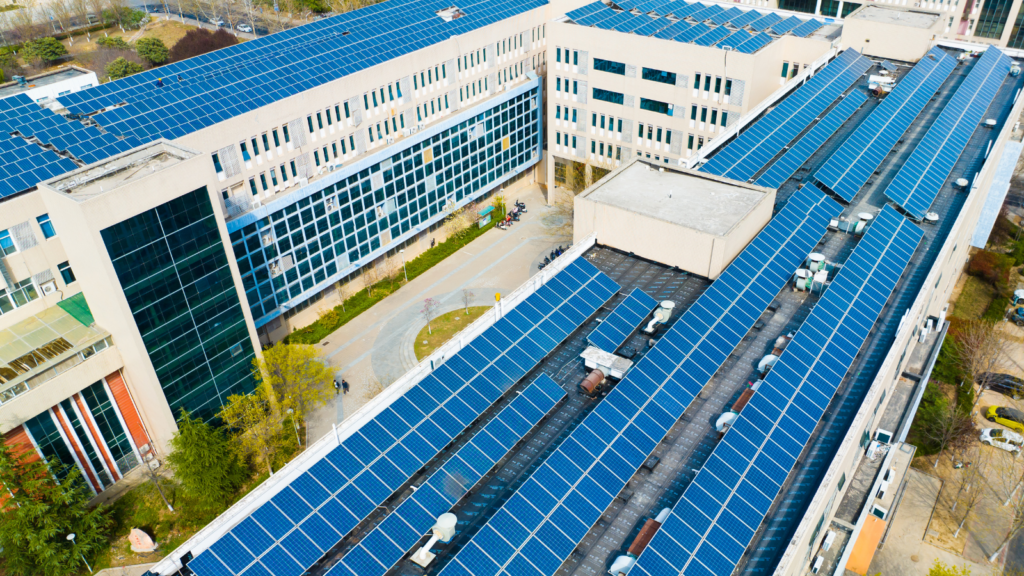
That’s why more districts are looking seriously at solar for schools as a long-term strategy to cut electricity costs, reduce emissions, and turn their buildings into living climate labs.
They’re not starting from scratch. The Toronto District School Board (TDSB), for example, now has roughly 38 megawatts (MW) of solar PV across 350+ buildings, making it one of the largest school solar portfolios in North America.
In Alberta, the Solar for Schools Program helped dozens of school authorities install grid-tied solar arrays while requiring a student education component as part of every project.
Put simply: solar on schools is no longer experimental. It’s a proven way to align budgets, buildings, and climate goals.
But if you're thinking about installing Solar Panels on a School, here are the important questions:
This Solar for Schools Guide is Built for:
- 🧑💼 Superintendents, Secretary-Treasurers, and CFOs
- 🏫 Facilities and operations managers
- 🌍 Sustainability / climate action leads
- 🧑🏫 Trustees and school council leaders
You’ll get a deep dive into:
- How solar for schools actually works
- Typical cost ranges and project sizes
- Funding and incentive stacks (including how tax credits can still help schools via partners)
- Educational and ESG benefits
- Detailed project lifecycle—from first idea to commissioning
- Risks, challenges, and how MAG Solar helps you de-risk them
🏫 The Bigger Picture: Why Schools are Moving to Solar
Energy is a major and rising cost for school boards
According to Natural Resources Canada’s benchmarking snapshots, K–12 schools are a substantial slice of public-sector energy use, with thousands of buildings tracked in ENERGY STAR Portfolio Manager.
Electricity prices vary by province and utility, but the pattern is familiar to every business manager:
- 📈 Electricity rates tend to trend upward over time.
- 💡 Demand charges and time-of-use rates can bite into operating budgets.
- 💵 Tight budgets leave little room to absorb spikes.
Solar doesn’t magically remove energy costs, but it does something incredibly valuable for long-lived public buildings:
It locks in a portion of your energy supply at a relatively fixed lifetime cost.
For a 25–30 year asset like a school, that kind of budget predictability is golden.
Climate commitments and public expectations:
🥬 Carbon-neutral or net-zero targets
🌍 District-level climate action plans
💡 Energy and GHG reporting frameworks
Solar is one of the most visible, measurable ways to show progress:
- 🔋 Every kWh from the array displaces grid electricity.
- 🏭 Emission reductions can be quantified and reported annually.
- 🙂 The public can actually see the infrastructure on the roof or carport.
📖 Education and culture change
Students are not passive in this story. They’re asking hard questions:
- “What is our school actually doing about climate change?”
- “Why are we teaching about sustainability but still running on fossil-heavy power?”
Boards like TDSB have embraced this by building programs like Action Solar Schools, where the solar installations are used in curriculum and environmental leadership initiatives.
Solar becomes:
- A live teaching tool (data, graphs, experiments, projects).
- A symbol of alignment between school values and operations.
A way to make students feel ownership and pride in their buildings.
🏫 How Solar for Schools Actually Works
Behind-the-meter solar: the basic setup
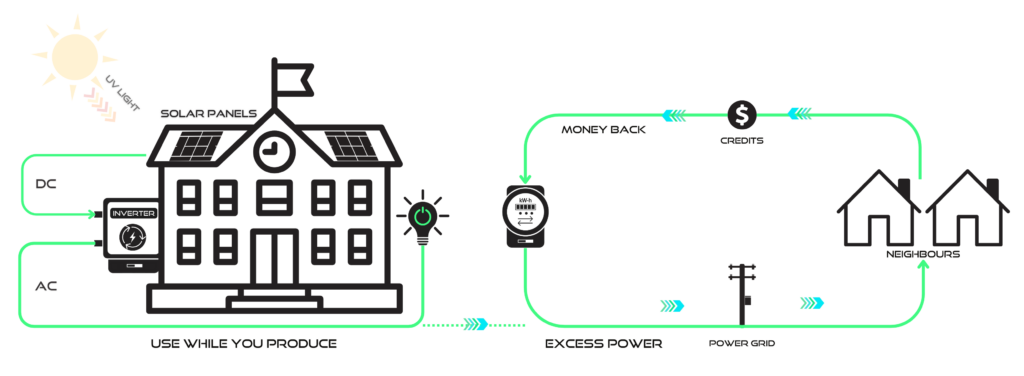
Most school solar systems in Canada are behind-the-meter grid-tied PV systems:
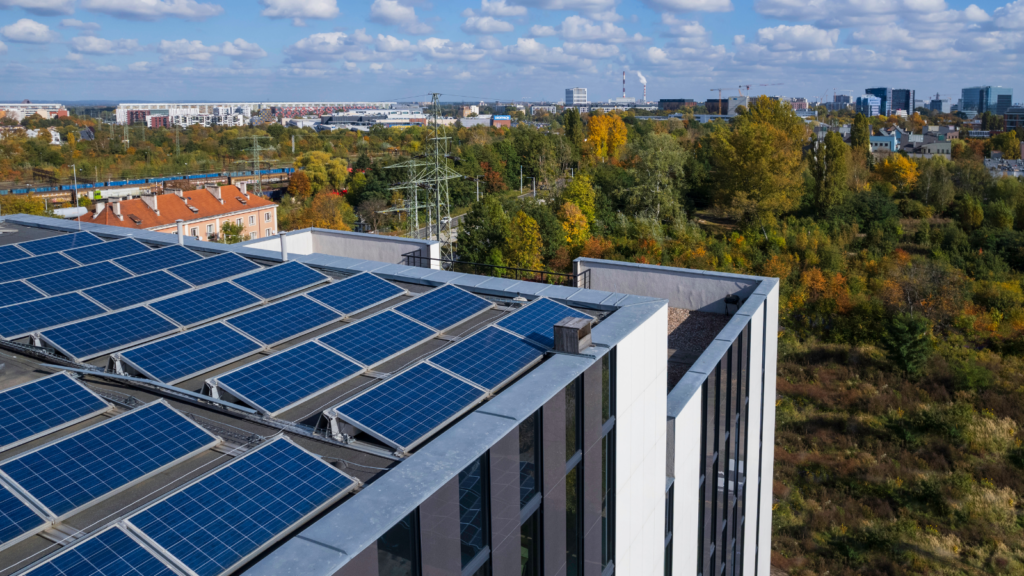
- Solar panels are mounted on the school roof, on carports, or as a ground-mount.
- Inverters convert DC power from panels into AC power compatible with the building.
- Solar power is fed into the school’s electrical distribution on the “load side” of the utility meter.
- The building uses solar energy first; the grid supplies any shortfall.
- When solar output exceeds on-site usage, surplus energy is exported to the grid.
Under net metering or self-generation rules (which exist in some form in most provinces), surplus exports earn credits—either in kWh or dollars—that offset electricity drawn from the grid at other times.
Net effect over a year: less net energy purchased from the utility, and lower costs.
🌇 Rooftop vs. ground-mount vs. solar carports
You can think of three main physical options:
Rooftop solar on school buildings
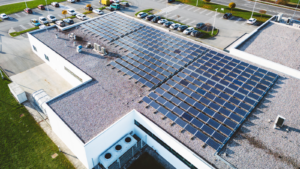
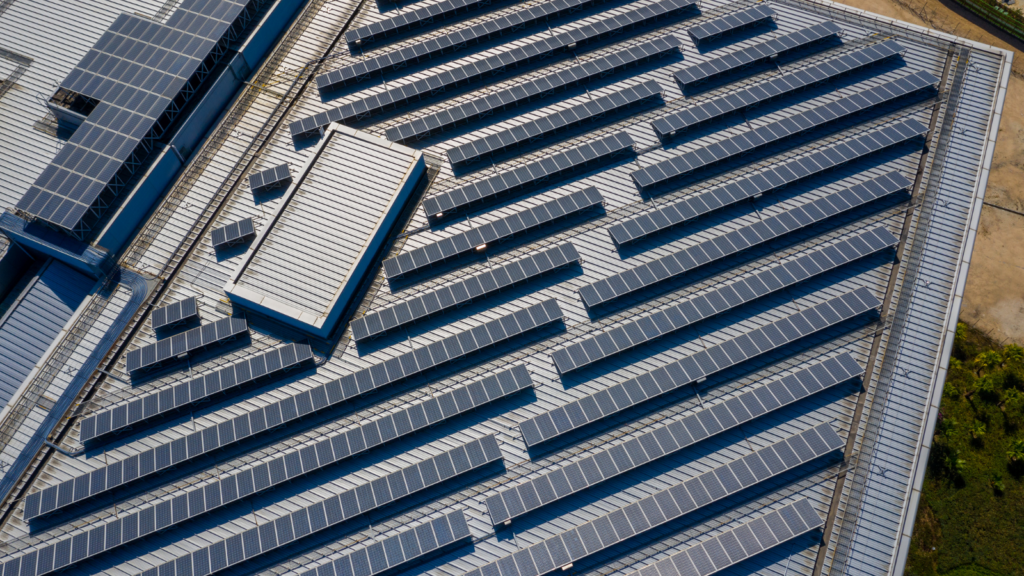
Ideal for flat or low-slope roofs on gyms, classroom blocks, and field houses.
Uses existing building footprint—no extra land needed.
Often lower cost per watt than elaborate structures.
This is the model used for the majority of TDSB’s 38 MW of solar.
Ground-mount solar on school lands

Great for rural schools or campuses with unused land or field edges.
Easier access for maintenance, potential future expansion.
Highly visible to students and community.
Ground-mounts are common in smaller communities where space isn’t as constrained and where simple post-and-rack structures can be installed efficiently.
Solar carports and canopies

Built over parking lots, bus loops, or drop-off zones.
Provide shade and weather protection for vehicles and pedestrians.
Very visible and ideal for communications and branding.
Carports add some structural cost but provide dual use: infrastructure + solar.
✅ Benefits of Solar for Schools: a Deeper Dive
Cost bands by system size
Actual pricing must be done site-by-site, but for planning:
- 50–200 kW rooftop systems
- Often fall in the $2.00–$2.50/W range, depending on roof complexity, access, and electrical work.
- Example: 100 kW × $2.20/W = $220,000 before incentives.
- 200–500+ kW systems (large high schools, multi-building campuses)
- Can benefit from economies of scale, with some projects falling in the $1.80–$2.30/W range.
- Example: 300 kW × $2.00/W = $600,000 before incentives.
Carports tend to be higher per watt due to steel and foundation work, but they add ancillary value: shading, weather protection, and a strong visual statement.
Example: small urban elementary school
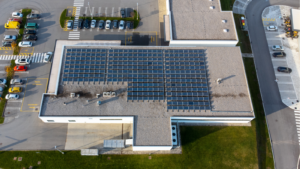
Load profile: ~250,000 kWh/year
PV system: 80 kW rooftop array
Installed cost: ~80,000 W × $2.30/W ≈ $184,000
If the system produces ~95,000–105,000 kWh/year and the board pays $0.13/kWh all-in, annual avoided cost might be:
- 100,000 kWh × $0.13 ≈ $13,000/year
Without factoring escalation or incentives, simple payback ≈ 14–15 years, with 10–15 more years of useful life beyond that.
Example: large high school campus
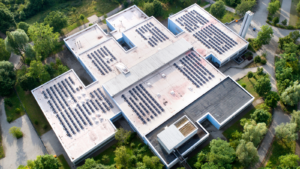
Load profile: 1,000,000+ kWh/year
PV system: 300 kW across gym, field house, and carport
Installed cost: 300,000 W × $2.00/W ≈ $600,000
If production is ~360,000–400,000 kWh/year and the effective rate is $0.12/kWh:
- 380,000 kWh × $0.12 ≈ $45,600/year in avoided costs
Again, not including escalation or incentives, that’s a simple payback around 13 years, with long-term upside as power prices rise.
These are illustrative examples. MAG Solar would always build site- and province-specific models.
🔧 Solar Panel Installation for Schools Across Canada

At MAG Solar, we design and deliver solar panel installation for schools across Canada, helping school boards turn their buildings into long-term clean energy assets. Whether you’re exploring solar for schools for the first time or building on existing sustainability work, our team specializes in solar energy for schools, school solar projects, and district-wide solar planning tailored to your facilities and budget.
Solar for Schools in British Columbia
We work with school districts throughout British Columbia, from the Lower Mainland and Vancouver to the Fraser Valley and Okanagan. Many BC schools have large, flat roofs that are ideal for solar panels for schools, and can integrate solar into existing capital and carbon-neutral planning. If you’re a BC facilities manager or energy lead, MAG Solar can help you evaluate school solar projects in Vancouver, the Lower Mainland, and Okanagan communities, showing you how rooftop solar and potential carport systems can reduce electricity costs and support CleanBC-aligned climate goals.
Solar Panel Installation for Schools in Alberta (Edmonton & Calgary)
In Alberta, MAG Solar supports school authorities in Edmonton, Calgary, and surrounding regions with complete solar panel installation for schools—from feasibility studies to engineering, construction, and monitoring. Alberta’s strong solar resource makes solar energy for schools especially attractive, and we understand how to structure school solar projects around provincial programs, municipal climate plans, and potential PPA models. If you’re considering solar for schools in Edmonton or Calgary, we can show you how much roof space you need, what your projected savings look like, and how to phase projects across your portfolio.
Solar for Schools in Manitoba (Winnipeg and Beyond)
For school divisions in Manitoba, especially in and around Winnipeg, MAG Solar designs solar energy systems for schools that align with local electricity rates and available incentives. Many Winnipeg-area schools have strong potential for solar panels for schools on gyms, classroom blocks, or combined rooftop and ground-mount designs. Our team can help you understand how solar panel installation for schools in Winnipeg fits with Efficiency Manitoba programs, district energy goals, and long-term capital planning.
Solar Energy for Schools in Nova Scotia (Halifax & Surrounding Areas)
In Nova Scotia, MAG Solar supports solar for schools and education-focused solar projects in Halifax and surrounding communities. With the province expanding community and non-profit solar opportunities, there is growing interest in school solar projects that combine cost savings with climate education. If you’re exploring solar panel installation for schools in Halifax or elsewhere in Nova Scotia, we can help you evaluate rooftop, carport, or community-linked solar options and show how they can support your board’s sustainability and STEM learning objectives.
🪙 Funding & Incentive Stack for Schools
Provincial programs and capital envelopes
Alberta – Solar for Schools (program design as a template)
The Solar for Schools Program in Alberta (administered by the Municipal Climate Change Action Centre) is a good blueprint for how provincial support can work:
- It provided financial rebates to Alberta public school authorities installing grid-connected solar PV systems on new or existing schools.
- It required participants to complete a student education initiative as part of the project.
While individual program rounds open and close, the structure—capital funding + education—shows what’s possible when provinces get behind school solar.
The Municipal Climate Change Action Centre (MCCAC) continues to offer programs that help municipalities and school authorities lower energy costs and GHG emissions.
British Columbia – Carbon Neutral Capital Program (CNCP) and capital streams
In BC, the Carbon Neutral Capital Program provides funding to reduce emissions and improve energy efficiency in K–12 schools—supporting projects like HVAC upgrades, electrical improvements, and other carbon-reducing measures.
At the same time, the province’s K–12 capital programs fund site acquisition, new construction, and renovations, with districts submitting capital plans based on their priorities.
Solar can often be:
- Included within major capital projects (new schools, additions, seismic upgrades).
- Paired with CNCP-funded mechanical or electrical upgrades as part of a broader decarbonization plan.
Manitoba – Efficiency Manitoba Solar Rebate (commercial + institutional)
In Manitoba, the main provincial support for solar is through Efficiency Manitoba’s Solar Rebate Program. They currently offer a per-watt rebate for commercial customers on buildings connected to Manitoba Hydro’s grid:
- Efficiency Manitoba’s Solar Rebates for Your Business page lists a rebate of $0.75 per DC watt installed for commercial solar PV systems, for buildings on a commercial general service electricity rate.
- The commercial program guide notes that rebates are capped at 50 kW and $25,000 per project, with larger systems still allowed but only the first 50 kW eligible for the rebate.
Because eligibility is based on having a commercial general service Manitoba Hydro account, many public and institutional buildings (including schools) can fall under this commercial customer category, as long as the individual school has its own meter and meets the rate criteria. Boards need to check on a site-by-site basis, but in practice:
- A school with its own commercial general service meter can often qualify for the commercial solar rebate.
The rebate stacks with federal Clean Technology Investment Tax Credit (for taxable project partners) and accelerated depreciation when projects are structured through third-party or special-purpose entities.
Nova Scotia – Solar for Non-Profits & Community Solar
Nova Scotia doesn’t have a “Solar for Schools” program like Alberta, but there are two key pieces your should know about:
1. Solar for Non-Profit Organizations (pilot, via Efficiency Nova Scotia)
Efficiency Nova Scotia runs a Solar for Non-Profit Organizations pilot, funded by the Province, that helps eligible groups install grid-tied PV:
- Registered non-profits and charities can qualify for a rebate of $0.60 per watt (DC) installed, covering up to 25% of system costs before HST, with a maximum of $15,000 per project.
Some school-adjacent organizations (education foundations, registered charities that support schools, etc.) may be able to leverage this when they are the formal project owner. It’s not a direct school-board capital program, but it’s relevant for non-profit educational projects and partnerships.
2. Nova Scotia Community Solar Program
In 2024, Nova Scotia launched a Community Solar Program, aimed at creating community solar gardens and expanding access to solar:
- Eligible project owners include non-profits, co-operatives, municipalities, First Nations communities, businesses, universities and colleges, and other community entities.
- Projects are 0.5–10 MW AC community solar gardens that feed into the provincial grid; subscribers then buy a share of the output at a slightly lower power rate.
While this isn’t a classic “put panels on the school roof” rebate, it does open up options for schools and post-secondary institutions to:
- Act as hosts or co-owners of a community solar garden, or
Participate as subscribers, tying part of their load to a local solar project.
Community & Education-related Funding
Solar projects are highly “fund-able” from non-traditional sources:
- EcoSchools Canada regularly curates eco-funding opportunities that can help support school-based environmental projects, sustainability initiatives, and climate education—sometimes including parts of solar projects or their educational integration.
- Green energy donors and foundations (e.g., organizations like Bullfrog Power or local community foundations) have funded school solar installations as visible community climate projects.
- Parent councils, alumni, and corporate sponsors often like highly visible, long-lived infrastructure that can be named or recognized (e.g., “XYZ Community Solar Learning Roof”).
These sources typically don’t fund the entire system, but they can:
- Cover a gap between other capital sources.
- Fund dashboards, signage, and curriculum development.
Provide match funding for climate or education grants.
⚠️ Risks, challenges, and how to de-risk them
Solar on schools isn’t zero-risk—but most challenges are manageable with good planning.
Roof condition and remaining life
❌ Risk:
- Installing solar on a roof that needs replacement in 5 years will create future removal/reinstallation costs.
✅ Mitigation:
- Align roofing and solar in capital planning.
- Use roof condition reports to decide where to prioritize ground-mounts or carports instead.
Structural capacity & code compliance
❌ Risk:
- Unverified structural capacity or overlooked snow/wind loads could create safety issues.
✅ Mitigation:
- Always use qualified structural engineers for load analysis and stamping.
- Choose mounting systems that work with your roof type and warranty.
Utility interconnection constraints
❌ Risk:
- Limited capacity on a feeder or transformer may restrict system size.
✅ Mitigation:
- Early utility engagement; design with realistic export limits.
- Consider smaller systems or staged expansion where necessary.
Stakeholder resistance and misconceptions
😬 Common concerns:
- “Will solar damage the roof?”
- “Will it interfere with fire access?”
- “Is maintenance a big burden?”
✅ Mitigation:
- Transparent explanation of mounting methods, fire pathways, and O&M routines.
- References to other boards (e.g., TDSB, Calgary Board of Education) that have successfully deployed solar.
MAG Solar’s job is to surface these concerns early and address them with clear documentation and examples. In addition, MAG Roofing provide school’s discounts on roofing when combined for solar.
🧑🏫 Bringing solar into the classroom: ideas for schools
Solar is one of those projects that begs to be integrated into student life. Some ideas you can include in your blog (and that MAG Solar can support conceptually):
🖥️ Solar dashboard in the lobby: Big screen showing live production, carbon savings, and fun “equivalents” (homes powered, trees planted).
🧮 Grade 5–8 math projects: Students graph daily production, calculate averages, and compare months or seasons.
🔍 High school physics labs: Measure panel voltage/current under different conditions, estimate efficiency, and compare to monitoring data.
🌿 Leadership & eco-club initiatives: Student teams present solar data at assemblies, to trustees, or at community nights.
🎖️ Cross-school competitions: In districts with multiple solar schools, friendly contests for “highest solar yield per student” or “biggest GHG reduction this year.”
Linking this to EcoSchools Canada or similar certification programs amplifies the impact and can help unlock additional funding.
👷 Project Lifecycle: How MAG Solar Delivers Solar for Schools
Here’s a more detailed, “board-level” breakdown of how a school solar project progresses.

Phase 1 – Portfolio discovery & alignment
Goal: Understand your buildings, budgets, and climate goals.
Activities:
- Review district capital and climate plans.
- Pull 12–24 months of electricity bills for candidate schools.
- Review existing building condition reports (BCRs), roof assessments, and seismic plans.
- Identify early “good candidates” (big roofs, high loads, good timing).
Deliverable:
A high-level opportunity map: which schools, approximate sizes, and how solar aligns with current initiatives.
Phase 2 – Technical pre-feasibility
Goal: Confirm which sites are technically viable and roughly what they can host.
Activities:
- Site visits (or drone/satellite review) to check roof types, obstructions, and shading.
- Preliminary structural review (building age, construction type, snow loads).
- Electrical service review (main switchgear ratings, transformer capacity).
Deliverable:
For each site: a conceptual layout, estimated system size (kW), expected annual production (kWh), and rough order-of-magnitude (ROM) cost.
Phase 3 – Business case and funding strategy
Goal: Build a credible, decision-ready business case for senior administration and trustees.
Activities:
- Model energy savings over 25–30 years for different system sizes.
- Apply local net-metering / self-generation rules, export credits, and escalation assumptions.
- Layer in potential funding sources: provincial capital programs, CNCP (BC), Solar for Schools–style rebates, community grants, PPA scenarios, etc.
- Incorporate GHG reduction estimates for climate reporting.
Deliverable:
A board-ready business case: scenarios (e.g., “5-school Phase 1”, “district-wide rollout”), costs, savings, emissions reductions, and funding options.
Phase 4 – Approvals & engagement
Goal: Secure internal and external support.
Activities:
- Present to senior leadership, facilities committees, and trustees.
- Prepare briefing notes that explain solar in clear, non-technical terms.
- Coordinate with utilities, ministries, and municipalities where needed.
- Support communications with staff, parents, and media.
Deliverable:
A set of approved projects and budgets, aligned with funding envelopes and district timelines.
Phase 5 – Detailed design & procurement
Goal: Turn the concepts into engineered, buildable projects.
Activities:
- Structural engineering (loading checks, attachment design).
- Electrical engineering (single-line diagrams, protection, interconnection).
- Detailed layout and conduit routing plans.
- Utility interconnection applications and approvals.
- Procurement of modules, inverters, racking, and BOS components.
Deliverable:
Stamped drawings, utility approvals, and a final fixed-price EPC contract or bid package (depending on procurement strategy).
Phase 6 – Construction & commissioning
Goal: Build safely, minimize disruption, and get the system online.
Activities:
- Schedule work for summer, breaks, or off-hours where possible.
- Mobilize crews, set up safety barriers and signage.
- Install racking, modules, inverters, wiring, and monitoring equipment.
- Perform testing, inspections, and utility witness (if required).
- Commission the system and confirm performance.
Deliverable:
- A fully commissioned solar system with documentation, as-builts, and O&M guidance.
Phase 7 – Monitoring, maintenance & education integration
Goal: Make the system perform and matter for the long term.
Activities:
- Configure monitoring dashboards for facilities staff and classrooms.
- Train custodial and maintenance staff on basic checks and response procedures.
- Provide lesson ideas and curriculum tie-ins for teachers, where requested.
- Offer performance monitoring and maintenance plans.
Deliverable:
A long-lived asset that continues to save money, reduce emissions, and support learning for decades.
☀️ Ready to Explore Solar for Your School?
If you’ve read this far, you’re probably already thinking of specific roofs, schools, or campuses in your district.
MAG Solar provides solar for schools and solar panel installation for schools across Western Canada, including British Columbia, Alberta, Manitoba and Nova Scotia. We work with school boards and facilities teams in cities like Vancouver, the Lower Mainland, the Okanagan, Calgary, Edmonton, Winnipeg and Halifax to design and build solar energy systems for schools that cut electricity costs, reduce emissions and support STEM learning.
Whether you’re planning a single school solar project or a district-wide rollout, our team can help you scope, fund and deliver the right solar solution for your schools.
MAG Solar can help you turn that “what if” into real numbers with a free, no-obligation solar assessment for your school or school board.
During your assessment, we will:
✅ Review your recent electricity usage for one or more schools
✅ Identify your best roof, carport, or ground-mount solar candidates
✅ Estimate system size, annual production, and potential bill savings
✅ Highlight applicable incentives and funding options in your province
✅ Outline the next steps if you decide to move forward
👉 Take the first step toward solar for your schools.
Contact MAG Solar today to request your free solar assessment.
- Let's Connect
Get a Free School Solar Assessment
See How Much you Can Save with Solar. Get your Free Design & Consultation
For many school districts, yes. Solar can reduce annual electricity costs, hedge against future rate increases, and deliver measurable GHG reductions that support climate and carbon-neutral goals. Real-world examples like the TDSB’s ~38 MW of rooftop solar and Alberta’s Solar for Schools Program show that school solar is practical and scalable, not just a pilot concept.
Many rooftop school systems fall in the $2.00–$2.50/W range, with larger projects sometimes dropping toward $1.80–$2.30/W. That translates roughly to $200,000–$250,000 for a 100 kW system, and $500,000–$700,000 for a 250–300 kW system, before incentives or any PPA structures. Exact pricing depends on roof condition, structural work, electrical capacity, access, and local labour and material conditions.
The Clean Technology Investment Tax Credit (CT ITC) is a refundable credit for taxable corporations, not tax-exempt school boards.
However, many boards benefit indirectly via PPAs or third-party ownership, where a developer owns the system, claims the CT ITC, and passes the value through in the form of lower solar electricity prices over the contract term.
Yes. Solar generates power whenever the sun is shining. When school loads are lower in summer, surplus energy is exported through net-metering or self-generation programs, generating credits that can offset usage at other times.
MAG Solar will always review roof condition and remaining life. If a roof is close to needing replacement, we may recommend bundling solar with a re-roof project or using a ground-mount / carport instead. This avoids having to remove and reinstall panels early.
MAG Solar will always review roof condition and remaining life. If a roof is close to needing replacement, we may recommend bundling solar with a re-roof project or using a ground-mount / carport instead. This avoids having to remove and reinstall panels early.
Most quality solar panels carry 25-year performance warranties, and many continue producing beyond that. Inverters typically last 10–15 years, with replacement expected once or twice over the project life. With proper design and maintenance, a school solar system can remain productive for 25–30+ years, serving generations of students.
Not compared to many other building systems. Typical maintenance includes periodic visual inspections, occasional cleaning where dust/pollen build-up is an issue, and correcting any issues flagged by monitoring. MAG Solar offers monitoring and maintenance plans so facilities staff are not left guessing.
Modern solar designs follow electrical and fire codes that require clear access pathways, labelling, and safe shut-down procedures. MAG Solar works with local authorities and fire departments to ensure that arrays maintain safe access and that roof layouts leave room for firefighting operations.
The easiest starting point is a portfolio-level energy review: gather 12–24 months of hydro bills for candidate schools and a list of buildings with basic roof and electrical information. From there, MAG Solar can identify strong candidates, sketch preliminary designs, estimate savings, and show how solar fits into your capital and climate plans.
A commercial solar project in Canada typically takes 4–9 months from initial assessment to final commissioning, depending on size and complexity. The on-site construction phase is usually only a few weeks; most of the time is spent on feasibility studies, engineering, utility approvals, permitting, and procurement. MAG Solar manages this process end-to-end: we handle your engineering, drawings, interconnection applications, and inspections so that your internal team doesn’t have to coordinate multiple contractors.
In many cases, solar panels on barns or farm buildings are treated as part of the property’s fixed assets and can be added to your farm insurance policy by updating coverage limits. Many lenders and appraisers view agricultural solar as an income-enhancing infrastructure upgrade, because it reduces operating costs and improves long-term cash flow. MAG Solar can provide documentation on system cost, production, and warranties that you can share with your insurer, banker, or appraiser.